I'm hiring!
As part of my UKRI Future Leaders Fellowship I'm looking to appoint a Postdoctoral Research Associate in Nuclear Arms Control and Disarmament.

Are you passionate about understanding and improving nuclear arms control and disarmament?
Do you have a PhD in political science, international relations or a related field working on nuclear weapons?
Do you want to spend the next two and a half years working with me to research and have impact in nuclear politics?
Or do you know someone who might?
If so, the good news is that I’m recruiting a Postdoctoral Research Associate in Nuclear Arms Control and Disarmament.
The successful candidate will work with me on my UKRI funded Future Leaders Fellowship ‘Atomic Anxiety in the Third Nuclear Age: How Can Arms Control and Disarmament Reduce the Risk of Nuclear War?’, and will contribute to the delivery of innovative research, impact, and knowledge exchange on nuclear weapons, arms control, and disarmament.
The ‘Atomic Anxiety in the Third Nuclear Age’ project seeks to investigate how the legitimacy of nuclear weapons, arms control, and disarmament is communicated and contested in the contemporary era. The project also aims to critically assess contemporary nuclear arms control and disarmament measures and advocacy.
The job is based at the University of Glasgow, Scotland, and the position is full time, fixed term for 2.5 years. The salary is £39,347 - £44,263 per annum.
You can check out more details and apply here!
The deadline for applications is July 23rd 2024.
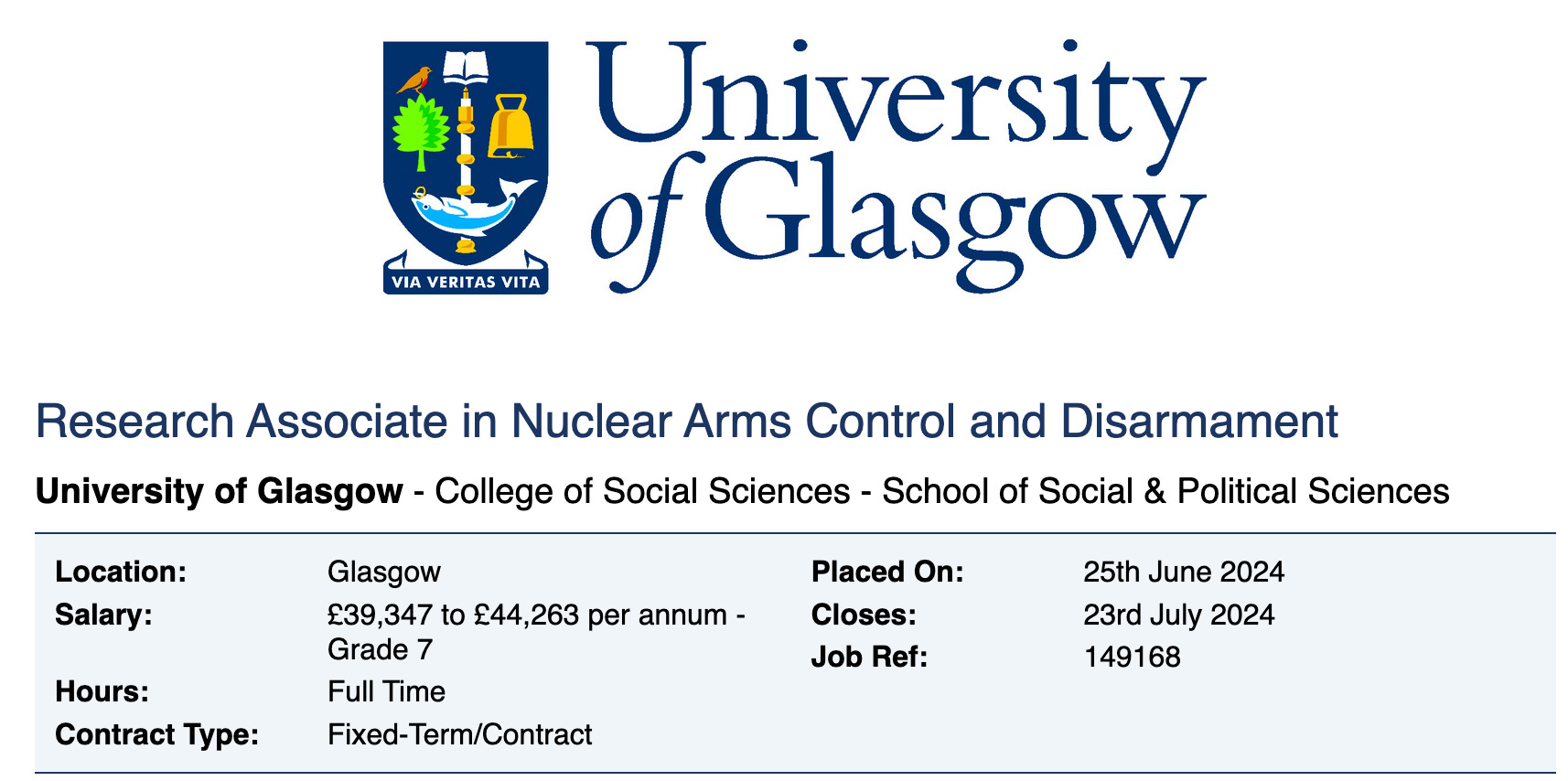
To apply you need to fill out the application form at the above link, and upload a CV & cover letter outlining how/why you meet the essential/desired criteria.
If you have any questions then drop me an email: Rhys.Crilley@Glasgow.ac.uk
My key pieces of advice for applications are:
Your cover letter should be 1-2 pages (I think 2 pages is pretty much the norm with these things) and should detail exactly how and why you meet the essential/desired criteria. This is key. If it’s not clear how you meet the essential criteria from your cover letter then its unlikely you will be shortlisted. Therefore it’s often helpful to use the language of the job advert and refer to the essential criteria explicitly in your cover letter, e.g. ‘I have specialist knowledge in the areas of nuclear weapons, arms control, and disarmament (A2) as I have recently completed a PhD on the topic of X, and published papers in journals A and B. These papers explore the issue of Y and Z, contributing to…’.
In your cover letter you need to demonstrate that you have the relevant knowledge, skills and experience in the field of nuclear politics, so you need to make sure it’s clear how you’ve contributed to this area already. However, it’s also a good idea to demonstrate how you will contribute to the field in future, and to emphasise how your research plans/goals align with the aims of the project. How would you contribute to researching and having impact in nuclear arms control and disarmament as part of the project for two and a half years? What would you research? How would you do it? Obviously a 2 page cover letter doesn’t leave much space for detail, but touching upon these questions is a good idea.
If you have not finished your PhD yet you should wait until you have submitted and had your viva before applying for this job (or other jobs). This is because meeting all of the essential criteria is a requirement to get shortlisted, and because the first essential criteria is a ‘Scottish Credit and Qualification Framework level 12 (PhD) or equivalent in professional qualifications and experience with evidence of personal development in similar role’, then it makes more sense to focus on getting your PhD done. The concern that hiring committees will have around shortlisting/appointing someone who doesn’t have their PhD yet is that they might end up having to work on revisions after the viva, and therefore wouldn’t be able to fulfil the duties of the position. The good news is that I will be advertising another Postdoctoral Research Associate position on this project in a year or so, so please keep your eyes peeled for that if you are one of the outstanding PhD students working on nuclear politics coming to the end of your PhD soon!